
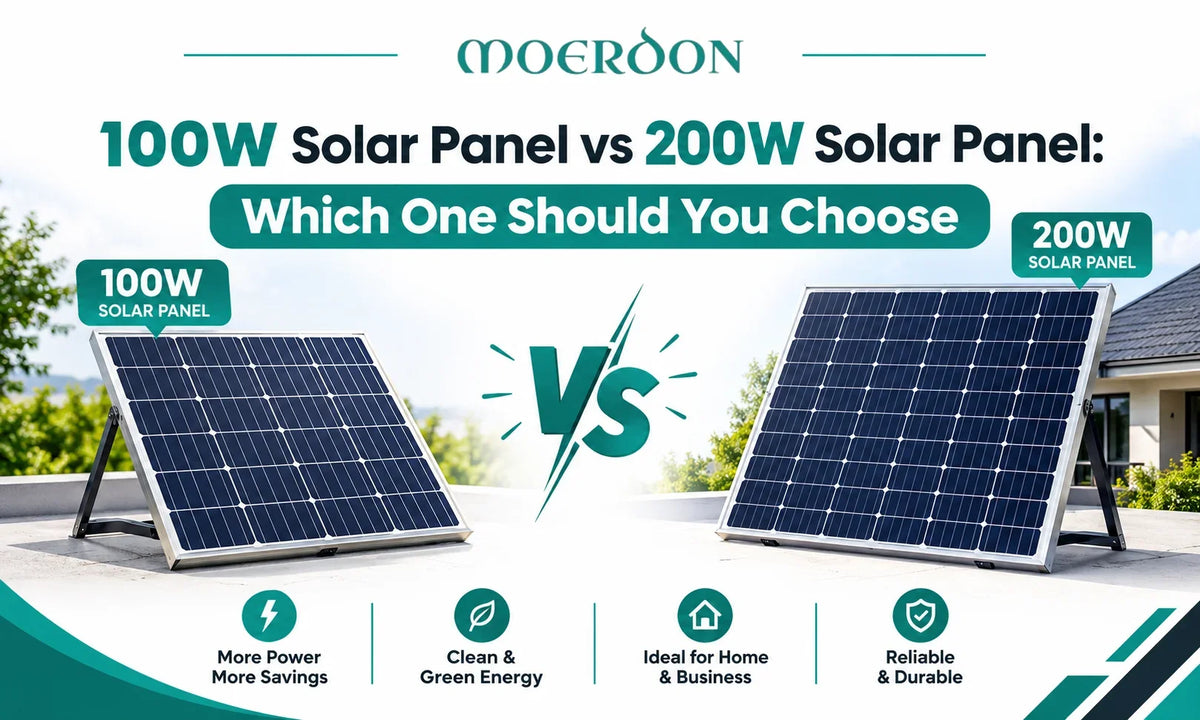
Quick Answer: A 100W solar panel is most suited for low-power and temporary usage, while a 200W panel is suitable for high power requirements, fast charging and for usage with recreational vehicles and off-grid systems. The choice will depend upon your energy requirement, available space, battery capacity, and your budget.
Introduction
The comparison of a 100-watt and a 200-watt solar panel is one of the most popular inquiries among customers before making any purchase. Irrespective of whether you are considering buying a solar panel for personal needs, for an RV, for camping, or for your business – choosing the right wattage is very important.
If you make a wrong decision, you might pay too much money or buy a solar panel which cannot produce enough energy for you.
Here, we present you the main differences between a 100w and a 200w solar panel. We hope that after reading this article you will be able to make the right choice. So, let’s start!
100W vs. 200W Solar Panels: Key Differences Explained
Before going deep, here is a simple side-by-side comparison:
| # | Feature | 100W Solar Panel | 200W Solar Panel |
|---|---|---|---|
| 1 | Daily Solar Panel Power Output | 300–500 Wh/day | 600–1000 Wh/day |
| 2 | Solar Panel Price (India) | ₹4,000–₹7,000 | ₹8,000–₹15,000 |
| 3 | Solar Panel Size | 100 × 67 cm | 150 × 100 cm |
| 4 | Weight & Portability | 5–7 kg Highly Portable | 10–14 kg Less Portable |
| 5 | Ideal Battery Size | 50Ah–100Ah | 100Ah–200Ah |
| 6 | Battery Charging Time | 5–6 hours | 6-8 hours |
| 7 | Low Light Performance | 20–40W output | 50–80W output |
| 8 | Panel Efficiency Rate | 17–20% | 18–21% |
| 9 | Charge Controller Required | 10A PWM/MPPT | 20A MPPT |
| 10 | Lifespan | 20–25 years | 20–25 years |
Daily Solar Panel Power Output and Energy Generation

A 100-watt solar panel will provide around 300 to 500 watt-hours per day based on the number of hours of full sunlight it gets. In the majority of Indian states, the number of hours of peak sun will be around 4 to 5 per day.
Taking an easy example,
- 100W × 5 hours = approximately 500Wh
- 200W × 5 hours = approximately 1,000Wh
Thus, 200 watts solar panels produce 600 to 1,000 watt-hours per day, which is almost double the wattage produced by a 100-watt panel.
In easier terms, a 100 watts solar panel will allow you to charge your mobile phone 15 to 20 times or run LED lights for 8 to 10 hours per day. Using 200 watts of solar energy, you will be able to do everything and have some surplus energy for running a computer or fan during the day.
Battery Capacity and Charging Requirements
It is important that your solar panel and battery match well to each other. If you don't match them, there is slow charging, waste of energy, or battery damage.
The 100W solar panel matches 50Ah to 100Ah battery well and is able to completely charge the 50Ah battery within 5 to 6 hours under decent sunlight conditions.
To be able to hold all energy generated by the 200W solar panel, you need 100Ah to 200Ah battery. Charging takes around 4 to 5 hours - faster and more efficiently.
If you have big batteries installed at home or in your RV, the 200W solar panel is better for you.
Physical Solar Panel Size and Installation Footprint
Solar panel size really does matter – particularly when it comes to roof area or space in a vehicle.
For instance, a conventional 100W solar panel is about 100 x 67 cm in size and can easily fit into a small rooftop, on the roof of a van, or even be mounted on a balcony railing.
A 200W solar panel is significantly bigger in size – 150 x 100 cm. In this case, you require more dedicated space for installing it properly.
In case you have limited space available, you can always use two 100W panels next to each other and achieve the same power output as from a single 200W panel.
Weight and Portability
If you move your panel frequently - for camping, travel, or seasonal use - weight becomes a serious factor.
A 100W panel weighs between 5 to 7 kg. Easy to carry, load into a car, and set up at a campsite by one person.
A 200W panel weighs 10 to 14 kg. It is heavier, bulkier, and generally needs a fixed mounting setup. Not ideal for people who need to pack and unpack regularly.
For portable and travel use - 100W wins clearly. If you want something even easier to carry, check our foldable solar panels. For fixed installations where power output matters more than portability - 200W is the better choice.
Charging Speed and Performance in Low-Light Conditions
Both panels perform differently on cloudy days or during early morning and late evening hours.
A 100W panel in low-light conditions may produce only 20 to 40 watts - enough to slowly trickle-charge a small battery but not enough to run appliances simultaneously.
A 200W panel in the same low-light conditions produces 50 to 80 watts - giving you noticeably better performance and keeping your battery from draining during cloudy stretches.
If you live in a region with frequent cloudy weather - like coastal areas or hilly regions of India - a 200W panel gives you much better reliability throughout the year.
Intended Application and Lifestyle
This is perhaps the most important factor. Your actual usage decides everything.
A 100W panel is enough for:
- Charging smartphones and tablets
- Running LED lights for 8–10 hours
- Powering a small fan occasionally
- Basic camping or weekend getaways
A 200W panel is better for:
- Running a laptop continuously
- Powering a small refrigerator
- Charging a laptop + phone + lights simultaneously
- Full-time off-grid or RV living
Upfront Cost and Cost per Watt

100W solar panel price in India typically ranges from ₹3,000 to ₹7,000 depending on the brand and panel type (monocrystalline or polycrystalline).
200W solar panel price in India ranges from ₹8,000 to ₹15,000.
When you calculate cost per watt - both panels offer similar value. However, a single 200W panel is often more cost-effective than buying two 100W panels separately because you save on mounting hardware, wiring, and installation time.
If budget is tight right now, start with a 100W panel. Most good solar systems are expandable - you can always add more panels later as your needs grow.
100W vs 200W Solar Panels for RVs: Which Is Better?
For RV users, this is a very common decision. Here is the honest answer:
A 100W panel works for RV users who are weekend travellers and only need to charge phones, run a few LED lights, and maybe power a small fan overnight.
A 200W panel is the right choice for full-time RV dwellers who need consistent power for laptops, a small fridge, a CPAP machine, or entertainment devices.
Many serious RV users actually install two 200W panels to cover all their power needs comfortably. Starting with one 200W panel gives you room to expand your system without replacing everything.
Choose a 100W Solar Panel If:
- You have light, occasional power needs
- Portability and compact size matter to you
- You are on a tight budget and just getting started
- You want to power a small campsite setup
- You already have a small 50–100Ah battery
Choose a 200W Solar Panel If:
- You need reliable daily power for multiple devices
- You live off-grid or travel full-time in an RV
- You want faster battery charging performance
- You live in a region with frequent cloudy weather
- You are building a long-term home solar setup
Find the Right Solar Panel for Your Energy Needs
At Moerdon Store, we offer high-quality solar panels designed for Indian conditions - built to perform in high heat, monsoon humidity, and varying sunlight levels across different regions.
Whether you need a compact 100W panel for travel or a powerful 200W panel for your home or RV - our solar range gives you reliable clean energy at an affordable price.
Explore our Solar Panel collection at Moerdon Store and find the perfect fit for your energy needs.
Frequently Asked Questions
Can I connect a 100W and 200W solar panel together?
Yes, you can connect them in parallel to increase total power output. However, both panels should have the same voltage rating for best results and safe operation.
Which is better - monocrystalline or polycrystalline for 100W and 200W panels?
Monocrystalline panels are more efficient and perform better in low-light conditions. They cost slightly more but are worth it for long-term use, especially in Indian weather conditions.
How many hours of sunlight do I need for a 200W solar panel to fully charge my battery?
In most parts of India with 4 to 5 peak sun hours daily, a 200W panel can fully charge a 100Ah battery in approximately 4 to 5 hours under clear sky conditions.
Is a 100W solar panel enough to run a fan all day?
A standard ceiling fan uses about 70 to 80 watts. A 100W panel can run a small DC fan during daylight hours but may need battery backup to run it continuously through the night. You can also look at our solar table fans for daytime use.
What is the lifespan of a 100W or 200W solar panel?
Most quality solar panels - regardless of wattage - last 20 to 25 years with minimal maintenance. Output efficiency reduces slightly over time, typically by 0.5% per year.


Leave a comment
This site is protected by hCaptcha and the hCaptcha Privacy Policy and Terms of Service apply.