
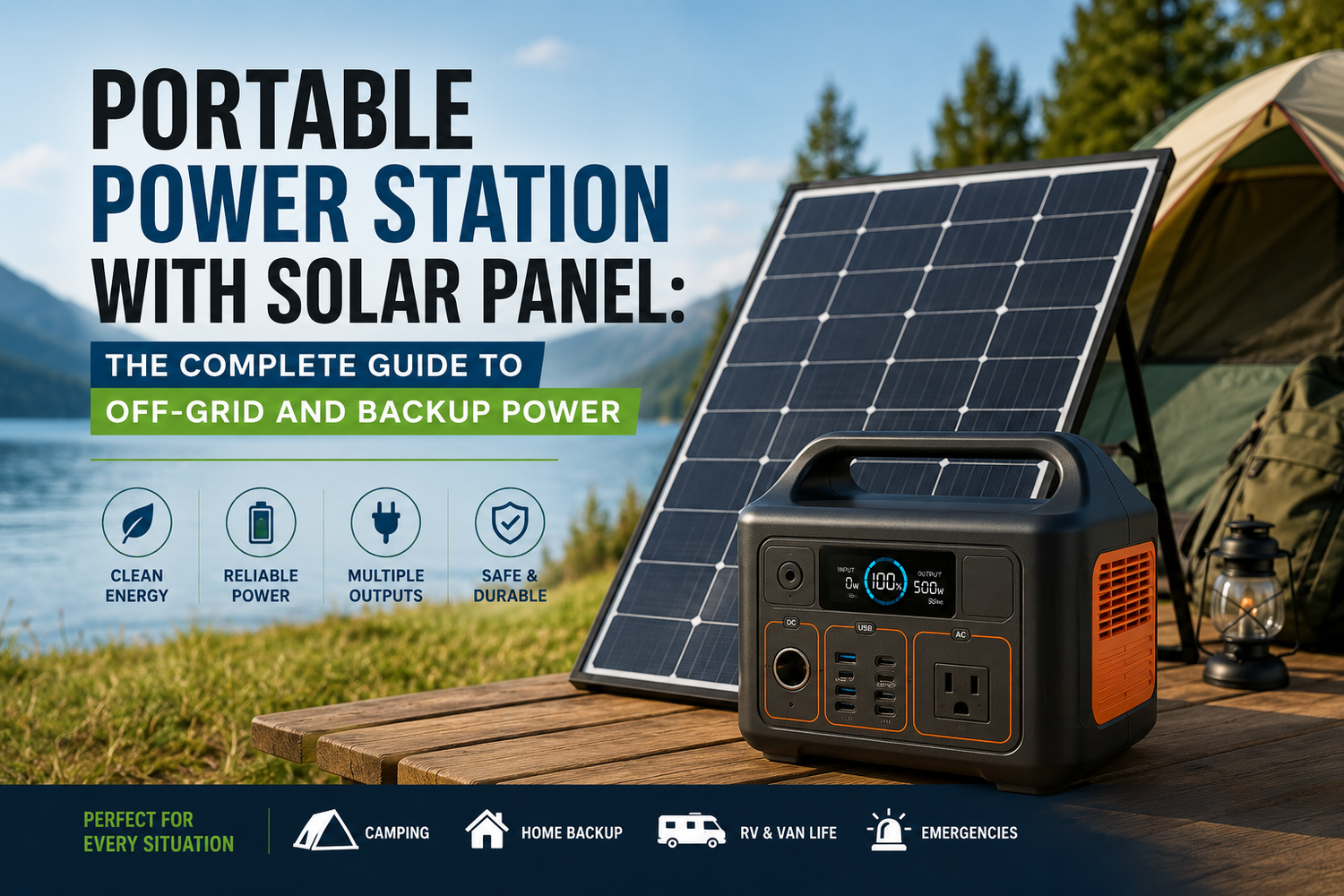
Power outages, remote work sites, off-grid living, and outdoor adventures all share one challenge: reliable access to electricity. A portable power station with solar panel solves this by combining a rechargeable battery unit with photovoltaic (solar) charging, giving users clean, portable, and renewable energy anywhere the sun reaches.
Unlike traditional gas generators, a solar powered portable power station produces no fumes, requires no fuel, and runs almost silently. This makes it a practical choice for campers, RV owners, homeowners preparing for outages, disaster preparedness planners, and eco-conscious consumers who want energy independence without the noise, maintenance, or emissions of combustion-based generators.
This guide explains how these systems work, what to look for when buying one, and how to use them safely and efficiently across camping, RV, home backup, and off-grid scenarios.
Key Concepts and Definitions
Portable Power Station A portable power station is a battery-based device that stores electrical energy and delivers it through AC outlets, USB ports, and DC outputs. It functions like a large, rechargeable battery pack for household and outdoor appliances.
Solar Panel Charging Solar panel charging refers to converting sunlight into direct current (DC) electricity through photovoltaic cells, which then charges the power station's internal battery.
Portable Solar Generator Often used interchangeably with "portable power station with solar panel," a portable solar generator is the combined system of a battery unit plus a foldable or rigid solar panel used to recharge it.
Off-Grid Power Off-grid power refers to electricity generated and stored independently of the public utility grid — a core use case for solar-charged battery systems.
Watt-Hours (Wh) Watt-hours measure total energy capacity. A higher Wh rating means the unit can power more devices for longer before needing a recharge.
How a Solar-Powered Portable Power Station Works
- Solar Collection – The solar panel absorbs sunlight and converts it into DC electricity via photovoltaic cells.
- Charge Controller Regulation – A built-in or external charge controller regulates voltage and current to protect the battery from overcharging.
- Battery Storage – Energy is stored in a lithium-ion (Li-ion) or lithium iron phosphate (LiFePO4) battery inside the power station.
- Power Inversion – An inverter converts stored DC power into usable AC power for standard household appliances.
- Output Delivery – Users draw power through AC outlets, USB-A/USB-C ports, DC carports, or wireless charging pads.
This cycle allows a portable battery power station to be recharged entirely through sunlight, without ever needing a wall outlet — a key advantage for off-grid portable power station setups.
Core Components of a Portable Solar Power System
| Component | Function |
|---|---|
| Battery Cell (Li-ion or LiFePO4) | Stores electrical energy for later use |
| Solar Panel(s) | Converts sunlight into electricity |
| MPPT/PWM Charge Controller | Optimizes solar energy input and protects battery |
| Inverter | Converts DC battery power to AC output |
| Battery Management System (BMS) | Monitors temperature, voltage, and charge cycles for safety |
| Display Panel | Shows battery percentage, input/output wattage, and estimated runtime |
Choosing the Best Portable Power Station with Solar Panel
1. Battery Capacity (Watt-Hours)
Match capacity to your use case:
- 300–500Wh – Charging phones, laptops, small camping gear
- 500–1,000Wh – CPAP machines, mini fridges, weekend RV trips
- 1,000–2,000Wh+ – Home backup for essential appliances, extended off-grid living
2. Battery Chemistry
LiFePO4 batteries generally offer longer cycle life and better thermal stability than standard lithium-ion, making them a preferred choice for a solar backup power station used frequently or in extreme temperatures.
3. Solar Input Wattage
Higher solar input (measured in watts) means faster recharge times. A 100W panel charging a 1,000Wh unit will take considerably longer than a 200W or 400W panel under identical sunlight conditions.
4. Output Ports and Pure Sine Wave Inverter
Look for a pure sine wave inverter, which safely powers sensitive electronics such as laptops, medical devices, and cameras without signal interference.
5. Portability and Weight
For portable power station for outdoor use, weight and carrying design matter as much as capacity — especially for hikers and backpackers.
6. Expandability
Some systems allow additional battery packs or solar panels to be added later, useful for scaling a portable power station for home backup system over time.
Best Use Cases by Audience
Camping and Hiking
A solar power station for camping powers lights, portable fridges, phones, and cameras without relying on car batteries or noisy fuel generators.
RV and Van Life
A portable power station for RV setups provides consistent power for fans, lighting, and small appliances while parked off-grid ("boondocking"), reducing dependency on campground hookups.
Home Emergency Backup
During grid outages, a portable power station for home backup can run refrigerators, routers, medical equipment, and lighting — a critical tool for disaster preparedness.
Off-Grid and Tiny Home Living
For those pursuing an off-grid portable power station lifestyle, solar charging enables sustainable daily power cycles without utility connections.
Field Work and Photography
Construction crews, photographers, and videographers working outdoors rely on these systems to charge tools, laptops, and camera batteries in remote locations.
Emergency Preparedness
An emergency solar power station ensures continuous power during natural disasters when grid electricity and fuel supplies may be disrupted.
Benefits of a Portable Power Station Connected with Solar Panel
- Renewable and clean energy – No fuel, emissions, or exhaust fumes
- Silent operation – Ideal for campsites, RVs, and residential neighborhoods
- Low maintenance – No oil changes, spark plugs, or fuel storage
- Energy independence – Reduces reliance on the grid or fuel stations
- Versatile power output – Supports AC, DC, and USB devices simultaneously
- Safe indoor use – Unlike gas generators, it produces no carbon monoxide
- Scalable capacity – Many systems support additional batteries or panels
Challenges and Considerations
- Weather Dependency – Cloudy or rainy conditions slow solar recharging significantly.
- Charging Time – Solar charging is generally slower than wall-outlet charging, particularly for larger battery capacities.
- Upfront Cost – High-capacity units with quality LiFePO4 batteries carry a higher initial investment than gas generators.
- Panel Placement – Solar panels require direct, unobstructed sunlight and periodic repositioning for optimal efficiency.
- Weight and Size – Higher-capacity units are heavier, which can limit portability for backpacking use cases.
Best Practices for Using a Portable Solar Battery Generator
- Position panels perpendicular to the sun and adjust angle throughout the day for maximum energy capture.
- Fully charge before storage and recharge every 3–6 months to maintain battery health during periods of inactivity.
- Avoid extreme temperatures — store and operate within the manufacturer's recommended range to protect the BMS and cell longevity.
- Prioritize essential loads first during outages (refrigeration, medical devices, communication) before charging non-essential electronics.
- Match solar panel wattage to battery input limits to avoid inefficient charging or wasted solar capacity.
- Keep firmware and battery management systems updated if the manufacturer provides app-based monitoring.
Industry Trends and Future Outlook
The portable power industry is shifting rapidly toward renewable energy portable power station technology, driven by:
- LiFePO4 adoption replacing older lithium-ion chemistries for improved safety and lifespan (often rated for 2,000–4,000+ charge cycles).
- Bidirectional charging integration, allowing power stations to double as home backup hubs connected to rooftop solar systems.
- Faster MPPT solar charging technology, reducing recharge times even in partial sunlight.
- App-based energy monitoring, giving users real-time visibility into consumption, solar input, and battery health.
- Growing demand from disaster preparedness markets, as climate-related grid instability increases interest in decentralized, solar-charged backup power.
Analysts across the renewable energy sector consistently point to declining solar panel costs and improving battery energy density as key drivers accelerating adoption of solar charging power station systems for both recreational and emergency use.
Frequently Asked Questions (FAQ)
1. What is a portable power station with a solar panel?
It is a battery-based power system that stores electricity and can be recharged using an attached or connected solar panel, providing renewable, portable electricity for outdoor, RV, or emergency use.
2. How long does it take to charge a portable power station with solar panels?
Charging time depends on battery capacity, solar panel wattage, and sunlight conditions. A 500Wh battery with a 100W panel in strong sunlight may take 6–10 hours, while higher-wattage panels or larger batteries will vary accordingly.
3. Can a portable power station run a refrigerator during a power outage?
Yes, many mid-to-large capacity units (500Wh and above) can run a standard refrigerator for several hours to over a day, depending on the fridge's power draw and the battery's total capacity.
4. Is a solar-powered portable power station worth it compared to a gas generator?
For most users, yes — it offers silent, fume-free, low-maintenance operation, though it typically has a higher upfront cost and depends on sunlight availability, unlike fuel-based generators.
5. Can I use a portable power station indoors?
Yes. Unlike gasoline generators, portable power stations produce no carbon monoxide, making them safe for indoor use during outages.
6. What size portable power station do I need for camping?
For basic camping needs (phone charging, lights, small fridge), a 300–500Wh unit is typically sufficient. Extended trips or larger appliances require 1,000Wh or more.
7. Do solar panels work on cloudy days?
Yes, but at reduced efficiency. Cloud cover can lower solar panel output significantly, so charging will take longer compared to direct sunlight conditions.
8. How long do portable power station batteries last?
LiFePO4 batteries commonly last 2,000–4,000+ charge cycles, translating to several years of regular use before capacity noticeably degrades.
Conclusion
A portable power station with solar panel setup offers a practical, sustainable, and increasingly essential solution for campers, RV owners, homeowners, off-grid enthusiasts, and disaster preparedness planners alike. By combining battery storage with renewable solar charging, users gain silent, low-maintenance, and fume-free power that adapts to camping trips, home outages, remote job sites, and everyday off-grid living.
As battery technology and solar efficiency continue to improve, these systems are positioned to become a standard component of both emergency preparedness kits and sustainable living setups.

Leave a comment
This site is protected by hCaptcha and the hCaptcha Privacy Policy and Terms of Service apply.