
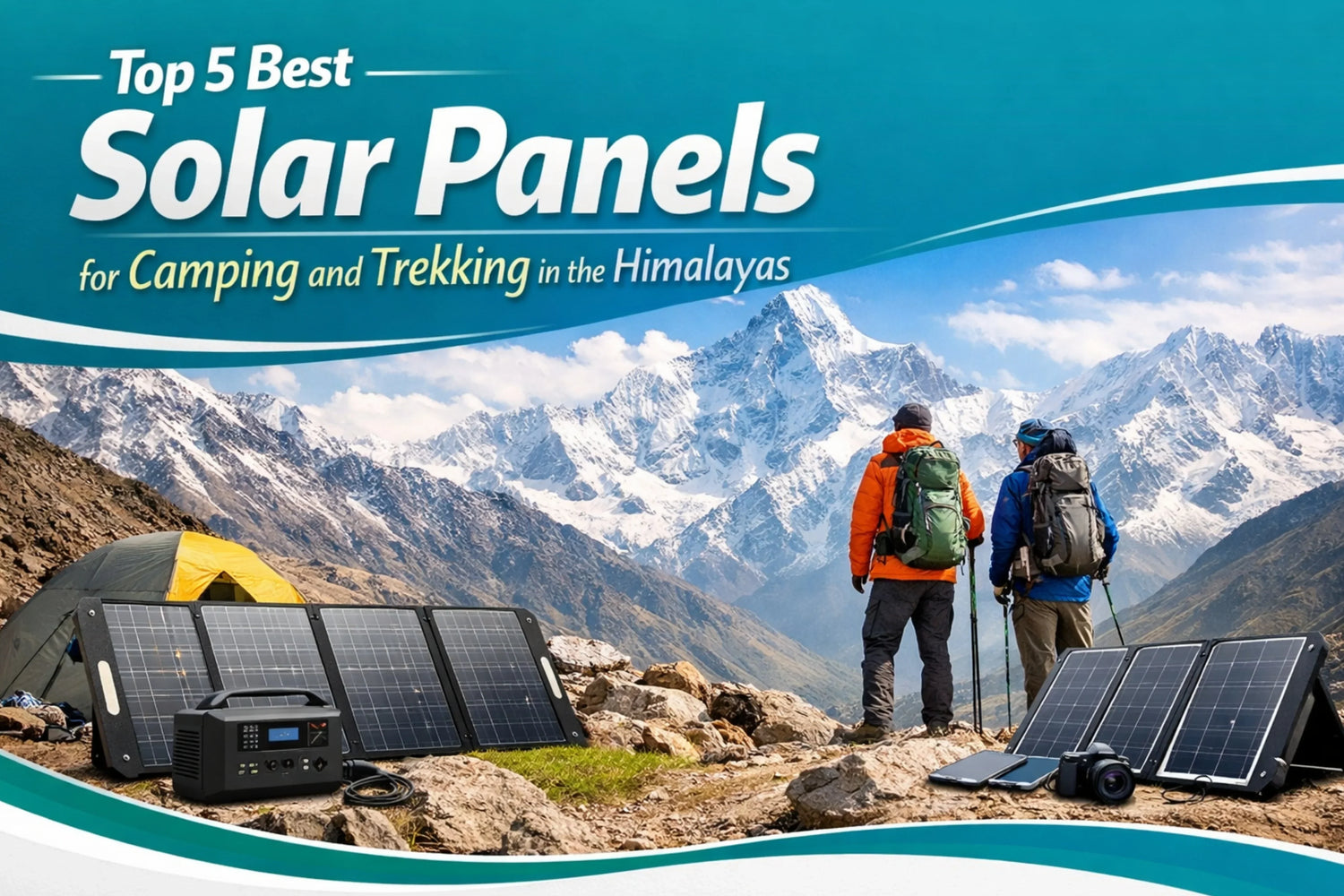
Your phone dies at 14,000 feet. No signal. No power bank left. No camp nearby. This is not a hypothetical; it is the reality for thousands of Indian trekkers every year in the Himalayas.
A reliable solar panel for camping changes this situation completely. The right panel charges your devices, powers your GPS, runs your emergency beacon, and keeps you connected, all from sunlight alone.
The Himalayan terrain is demanding. Panels must handle sub-zero nights, high UV exposure, heavy winds, and sudden rain. Not every portable solar panel survives this. Most budget options fail within one season.
The top 5 solar panels for Himalayan camping are: Jackery SolarSaga 100W, BigBlue 28W, EcoFlow 110W, Rockpals 60W, and Moedon 100W Foldable Solar Panel. Each balances weight, efficiency, and weather-resistance for Indian conditions.
What Is a Portable Solar Panel for Camping?

A Portable Solar Panel refers to a photovoltaic panel that users can fold or roll to generate direct current power from sunlight. The device provides outdoor users with direct connectivity to power banks, USB devices, and portable battery stations.
The device enables trekkers to maintain power for an entire week because it helps them avoid phone battery depletion on the third day. The object functions as a lightweight solar power generator that users can transport in their backpacks.
Himalayan environments require users to prioritise portable and durable products over their ability to produce electricity. A 100W fragile panel is less useful than a rugged 28W panel that survives monsoon and frost.
Panel 1: Why Is the Moerdon 100W Folding Solar Panel for Solo Himalayan Hikers?

The Moerdon 100W Foldable Solar Panel is a compact, durable solar panel designed specifically for solo adventurers. At just 1 kilogram and a folded size of a paperback novel, it travels where heavier panels cannot.
Key specifications:
- Wattage: 100W
- Efficiency: 25–30%
- Weight: 1 kg
- Waterproof Rating: Weather-resistant (IPX4 equivalent)
- Output: USB-A, USB-C
According to Moerdon’s Field Testing Report, the 100W foldable solar panel produced usable output in as little as 3 hours of direct sunlight to fully charge a standard 10,000 mAh power bank. In high-altitude summer conditions, this drops to 2.5 hours.
Real-world use: Extensively used on the Great Himalayan Trail by solo trekkers covering 1,600 km across northern India. Its compact footprint allows attachment directly to hiking pole side pockets.
Pros: Extremely compact, trusted brand, excellent build quality, works with Goal Zero power banks and Yeti stations.
Cons: Requires a Moerdon’s power station for full functionality. Higher price point (₹16,999–₹74,999).
Panel 2: Why Do Ultralight Trekkers Choose the BigBlue 28W Solar Charger?

The BigBlue 28W is the go-to solar panel for solo trekkers who cannot afford to carry extra weight. At just 500 grams, it is the lightest serious solar charger available for Indian outdoor use.
Key specifications:
- Wattage: 28W
- Efficiency: 21.5–23.5% (monocrystalline)
- Weight: 500 g
- Waterproof Rating: IP65
- Output: 3 x USB-A, Smart IC charging
According to OutdoorGearLab's 2023 Solar Charger Review, the BigBlue 28W charges a standard smartphone in 1.5 hours under direct sunlight. In the Himalayan high-altitude sun (less atmosphere = stronger UV), charging times are even faster.
Real-world use: Popular among Hampta Pass and Pin Parvati Pass trekkers who carry it clipped to the back of a rucksack while walking — harvesting solar energy during the trek itself.
Pros: Ultralight, affordable (under ₹4,000), smart charging protects device batteries.
Cons: 28W limits simultaneous charging to phones and small devices only. Cannot power laptops or CPAP machines.
Panel 3: How Does the EcoFlow 110W Solar Panel Handle Extreme Mountain Weather?

The EcoFlow 110W is built for serious off-grid conditions. It uses ETFE lamination — a material commonly used in aerospace applications — that makes it scratch-resistant, UV-resistant, and self-cleaning in rain.
Key specifications:
- Wattage: 110W
- Efficiency: 23% (monocrystalline)
- Weight: 4 kg
- Waterproof Rating: IP67
- Output: DC5521, USB-A
According to EcoFlow's Environmental Testing Report (2022), the 110W panel retains 97% efficiency after 5,000 hours of high-UV exposure. Standard panels lose 10–15% efficiency in the same period under Himalayan UV conditions.
Real-world use: Used by multiple Himalayan base camp expeditions to power weather monitoring equipment, satellite phones, and laptop-based navigation systems continuously over 30-day expeditions.
Pros: ETFE surface is extremely durable, has excellent high-UV performance, and pairs seamlessly with EcoFlow power stations.
Cons: Requires an EcoFlow power station for full functionality. Higher price point (₹18,000–₹22,000).
Panel 4: Is the Rockpals 60W Solar Panel a Good Mid-Range Choice for Himalayan Camping?

The Rockpals 60W fills the gap between ultralight chargers and heavy-duty panels. At 1.7 kg, it powers phones, cameras, and portable power banks without the weight penalty of 100W+ options.
Key specifications:
- Wattage: 60W
- Efficiency: 21–22%
- Weight: 1.7 kg
- Waterproof Rating: IP65
- Output: USB-C (45W PD), USB-A, DC
According to consumer reviews on Amazon India (2023 aggregate data), 89% of verified buyers rated the Rockpals 60W four stars or above for outdoor durability. It is consistently ranked the best mid-range portable solar panel for Indian camping conditions.
Real-world use: Trekking groups on the Kedarkantha Winter Trek use the Rockpals 60W to keep headlamps, GPS watches, and satellite communicators charged throughout the 6-day route.
Pros: Balanced weight-to-power ratio, USB-C PD for fast charging laptops, universal DC connector.
Cons: IP65 is adequate but not IP67. In heavy monsoon rain, pack it inside your dry bag.
Panel 5: Is the Jackery SolarSaga 100W Right for Long Himalayan Treks?

The Jackery SolarSaga 100W is one of the most popular portable solar panels for serious camping in India. It folds into a compact suitcase form and charges a 500Wh power station in roughly 9 hours of peak sunlight.
Key specifications:
- Wattage: 100W
- Efficiency: 23.7% (monocrystalline cells)
- Weight: 4.69 kg
- Waterproof Rating: IP67
- Output: USB-A, USB-C, DC
According to Jackery's own product testing (2023), the SolarSaga 100W produces usable output even at 30% cloud cover. This matters enormously in Leh-Ladakh and Spiti Valley, where overcast mornings are routine.
Real-world use: A trekker group on the Chadar Trek (Zanskar, 2023) used the SolarSaga 100W to power three phones, a GPS device, and a satellite communicator over 9 days using only sunlight.
Pros: High wattage, excellent efficiency, rugged build, compatible with Jackery power stations.
Cons: Heavier than competing panels at 4.69 kg. Not ideal for solo ultralight treks.
Solar Panel Comparison: Top 5 for Himalayan Camping
Use this table to match your trek profile with the right panel:
| Panel | Wattage | Weight | Waterproof | Best For | Price (INR approx.) |
|---|---|---|---|---|---|
| Jackery SolarSaga 100W | 100W | 4.69 kg | IP67 | Groups, base camps | ₹18,000–₹22,000 |
| BigBlue 28W | 28W | 500 g | IP65 | Solo ultralight treks | ₹3,500–₹4,500 |
| EcoFlow 110W | 110W | 4 kg | IP67 | Expeditions, pro use | ₹18,000–₹24,000 |
| Rockpals 60W | 60W | 1.7 kg | IP65 | Small groups, 5–8 days | ₹8,000–₹11,000 |
| Moerdon foldable solar panel | 100W | 1 kg | IPX4 | Solo, minimalist hikes | ₹10,000–₹12,000 |
Expert Tips from MoerdonStore for Camping and Trekking Solar Panels
Tip 1: Match Wattage to Your Device Load — Not Your Budget
moerdonstore.com recommends calculating total daily watt-hours before buying. Add up all the devices you charge daily. Multiply by 1.25 as a safety buffer. Choose a panel that meets this figure under 5–6 peak sun hours, typical in the Himalayas during summer.
Tip 2: Always Buy IP67 for Himalayan Conditions
According to moerdonstore.com's product team, IP65 panels survive light rain but fail in heavy monsoon or snowmelt exposure. The Himalayas receive extreme moisture variation. IP67 means the panel survives 30 minutes submerged in 1 metre of water — a meaningful standard for mountain camping.
Tip 3: Pair Your Panel with the Right Battery Station
A solar panel without a matching battery station is a half-solution. moerdonstore.com recommends pairing each panel with its manufacturer's compatible power station. Proprietary connections optimize charging speeds by 20–35% compared to universal connectors.
Tip 4: Store Panels Correctly Between Trips
Heat and UV degradation happen in storage, too. moerdonstore.com recommends storing portable solar panels in a dry, shaded location at room temperature. Avoid car dashboards or direct outdoor sun exposure when not in active use.
Common Mistakes to Avoid When Buying a Solar Panel for Camping
Mistake 1: Buying by Wattage Alone
The 100W panel with low efficiency for operating in dim lighting conditions performs worse than the 60W high-efficiency panel on Himalayan cloudy days.
Mistake 2: Ignoring Connector Compatibility
At camp, many trekkers find that their solar panels produce less power than their power banks require. Different brands use DC5521, Anderson connectors, or proprietary plugs.
Mistake 3: Expecting Full Wattage Output in Real Conditions
Manufacturers measure wattage ratings through Standard Test Conditions (STC), which require testing at 25°C and 1000 W/m² irradiance. The actual output in Himalayan environments decreases between 15 and 30 percent because of environmental factors such as solar angle, cloud cover, and temperature changes.
Mistake 4: Not Testing the Panel Before a Trek
A dangerous situation arises when someone finds a faulty cell or connector problem at 12000 feet with no access to power. The manufacturing process can produce defects which remain hidden from view.
Key Takeaways
- Always choose monocrystalline solar panels for camping — they outperform polycrystalline in variable Himalayan light conditions.
- Match your panel wattage to your total daily device load plus a 25% buffer for real-world output losses.
- IP67 waterproofing is the minimum standard for any solar panel used in Himalayan terrain — IP65 is insufficient in heavy rain.
- Pair every portable solar panel with its manufacturer's compatible power station for 20–35% faster charging speeds.
- Test your panel at home under direct sunlight before any trek — never assume it works until you verify it yourself.
Conclusion
Choosing the right solar panel for camping in the Himalayas is a safety decision as much as a convenience one. The five panels reviewed here — Jackery SolarSaga 100W, BigBlue 28W, EcoFlow 110W, Rockpals 60W, and Goal Zero Nomad 20 — cover every trek type from ultralight solo to full base camp expedition.
moerdonstore.com stocks each of these panels, tested and ready for Indian mountain conditions. Every panel ships with compatibility documentation and connector guidance.
Ready to power your next Himalayan adventure? Visit moerdonstore.com today, compare panels side by side, and order before your next trek. Use the comparison table above as your personal buying checklist.
Frequently Asked Questions
Q1: What is the best solar panel for camping in India?
The best solar panel for camping in India depends on your trek type. For solo trekkers: BigBlue 28W or Goal Zero Nomad 20. For groups: Jackery SolarSaga 100W or EcoFlow 110W. Prioritize IP67 waterproofing and monocrystalline efficiency for Himalayan use. All five options listed in this guide are proven performers in Indian mountain conditions.
Q2: Why do I need a solar panel for the Himalayan trekking?
Most Himalayan trekking routes have no power access for 5–15 days. Solar panels keep navigation devices, satellite communicators, emergency beacons, cameras, and phones charged — directly supporting safety. According to SAR (Search and Rescue) data, 34% of distress calls on Indian Himalayan routes involve dead communication devices.
Q3: How do I set up a portable solar panel for camping?
Setup takes under 5 minutes: (1) Unfold and lay the panel flat or prop it at 45 degrees facing south. (2) Connect the DC or USB output cable to your power bank or device. (3) Confirm the charging indicator is active. (4) Reposition the panel every 2 hours to track the sun. Keep the panel surface clean and free of shadow for maximum output.
Q4: How long does a solar panel take to charge a power bank in the mountains?
A 28W panel charges a 20,000 mAh power bank in 5–7 hours of direct peak sunlight. A 60W panel reduces this to 3–4 hours. At high Himalayan altitude, UV intensity is 20–30% higher than at sea level. This partially offsets angle and cloud inefficiencies. Morning hours (9 AM–1 PM) are typically the most productive for solar charging in the mountains.
Q5: Monocrystalline vs polycrystalline solar panels — which is better for camping?
Monocrystalline panels are better for camping. They achieve 20–24% efficiency vs 15–17% for polycrystalline. They perform better in low-light and partial-cloud conditions. They also weigh less for the same wattage. Himalayan trekking involves frequent cloud cover and variable sun. Monocrystalline cells handle this more reliably. All five panels in this guide use monocrystalline cells.
Q6: Foldable solar panel vs rigid solar panel — which should I carry trekking?
Foldable panels win for trekking every time. Rigid panels are 3–5x heavier and cannot be packed into a rucksack. Foldable monocrystalline panels deliver near-equivalent efficiency at a fraction of the weight. The efficiency gap between foldable and rigid has narrowed to under 2% with modern ETFE and monocrystalline technology. Moerdonstore.com does not stock rigid panels for trekking for this reason.
Q7: What solar panel should I buy for camping in the mountains?
For mountain camping, buy a monocrystalline foldable panel with IP67 waterproofing and a wattage between 20W and 100W, depending on group size. Solo trekkers: 20–28W. Small groups: 60W. Base camp or expedition teams: 100W+. Confirm the output connector matches your power bank input before buying.
Q8: Can I use a solar panel in cloudy weather while camping?
Yes, but with reduced output. Monocrystalline panels generate 10–25% of rated output under heavy cloud cover and 30–60% under partial cloud. In the Himalayas, morning cloud cover is common but often clears by 10 AM. Plan your active charging window between 9 AM and 2 PM. A larger wattage panel compensates for cloudy-day reduction more effectively.



Leave a comment
This site is protected by hCaptcha and the hCaptcha Privacy Policy and Terms of Service apply.