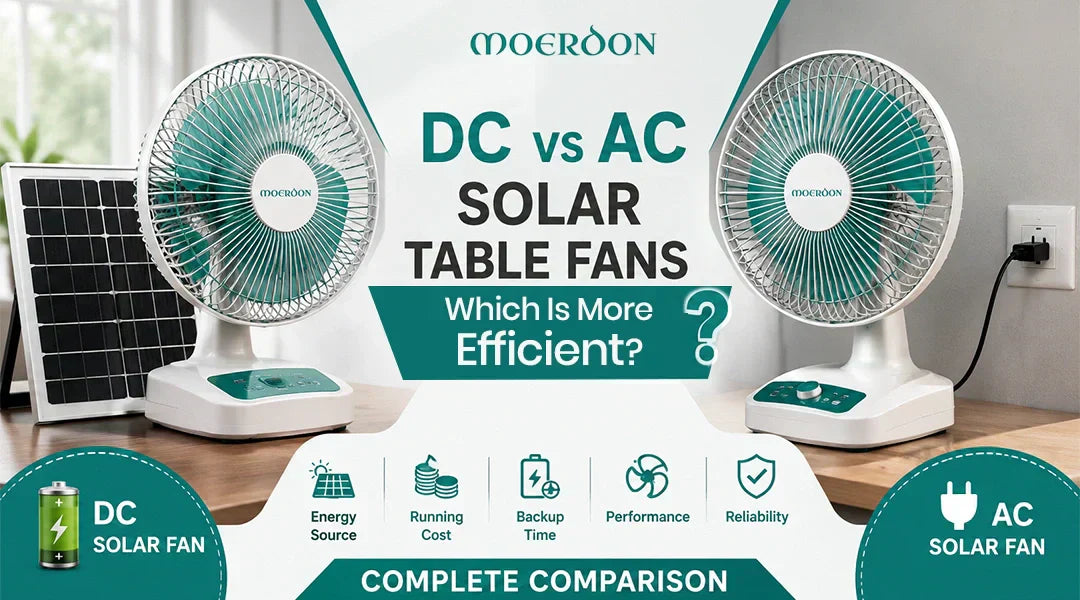
If you are comparing DC vs AC solar table fans, the simple answer is this: a DC solar table fan is usually better for direct solar use, battery backup, and low power consumption up to 50-70 watts than an AC solar fan. It works well with small solar panels and batteries, so it is useful during power cuts. An AC solar table fan is better only if you already have an inverter-based solar setup at home. For most people looking for a solar table fan for power cuts, rural use, or portable cooling, a DC fan is the smarter choice.
In this article we’ll break down the key differences between a DC solar table fan vs a AC solar table fan along with their advantages and disadvantages and real life practical usage options. This will make it easy for you to choose the best suited according to your need and use.
What Is a DC Solar Table Fan?
A DC solar table fan runs on direct current electricity. Solar panels naturally produce DC power, so a DC fan can work more efficiently with solar panels and batteries. It is commonly used in small solar kits, rural homes, shops, cabins, and areas where power cuts are common. This is a more eco-friendly option as compared to AC solar fans were the power consumption is 50-70 more than that of DC fans.
Example: A 25-watt DC-driven fan yields the same results as a 100-watt AC fan. This is ideal for commercial settings, like restaurants, allowing you to keep fans running all day without incurring astronomical electric bills.
How a DC Solar Table Fan Works
A DC solar table fan gets power from a solar panel, battery, or DC adapter. The fan motor uses DC power directly, so less energy is wasted. This makes it a good choice for small solar setups.
Main Features of DC Solar Table Fans
Common features include:
- Low power use (upto 50-70%) lower than AC solar fans
- Battery-friendly operation
- Portable design
- Solar panel compatibility
- Good backup during power cuts
- Suitable for small rooms and shops
Where DC Solar Fans Are Commonly Used
For villages and rural areas, DC solar fans are usually better. They can work with small solar panels and batteries. They are useful where grid electricity is weak or unavailable. They are a practical choice where electricity is not stable. DC solar fans are useful in:
- Villages
- Farmhouses
- Study rooms
- Cabins, small shops, and street stalls
- Power cut areas
- Solar home lighting kits
What Is an AC Solar Table Fan?
An AC solar table fan runs on alternating current electricity. This is the same type of electricity used in normal home sockets.
But solar panels do not produce AC power directly. So, if you want to use an AC fan with solar, you usually need a solar inverter.
How an AC Solar Table Fan Works
A solar panel produces DC power. The inverter converts this DC power into AC power.
Then the AC fan runs like a normal table fan. This setup works well if your home already has an inverter-based solar system.
Main Features of AC Solar Table Fans
Common features include:
- Works with normal home sockets
- Easy to find in the market
- Familiar design
- Easy repair in many areas
- Useful with solar inverter systems
- Suitable for regular home use
AC fans are common, but they are not the most efficient option for direct solar use.
Where AC Solar Fans Are Commonly Used
For city homes with an existing solar inverter, an AC fan can work well. But if the main goal is power saving and backup, a DC fan is still a better option. AC solar fans are commonly used in:
- City homes
- Offices
- Shops with inverter systems
- Homes with rooftop solar inverter
- Places with normal AC wiring
- Bigger solar setups
They are useful when the solar system already converts power into AC.
DC vs AC Solar Table Fans: Key Difference at a Glance
|
Feature |
DC Solar Table Fan |
AC Solar Table Fan |
|
Power type |
Direct current |
Alternating current |
|
Solar compatibility |
Better for direct solar and battery use |
Needs inverter |
|
Electromagnetic interference |
Minimal electromagnetic interference |
Higher electromagnetic interference compared to DC fans |
|
Power consumption |
Usually 50–70% lower than AC fans |
Usually higher than DC fans |
|
Noise level |
Quieter due to electronically commutated motor |
Not as quiet as DC fans |
|
Battery backup |
More efficient |
Less efficient due to conversion loss |
|
Portability |
Better |
Depends on setup |
|
Best for |
Solar kits, rural homes, backup use |
Homes with inverter solar systems |
|
Setup cost |
Usually lower for small solar setups |
Higher if inverter is required |
|
Voltage |
Generally uses lower voltage |
Usually available in higher voltage models like 115V |
|
Energy loss |
Lower |
Higher due to DC-to-AC conversion |
|
Repair availability |
May vary by area |
Usually easier |
|
Best user |
Power-saving and backup-focused users |
Users with existing inverter solar systems |
After understanding the differences, users who want to buy solar table fan should prefer DC models for better efficiency and lower power consumption in most cases.
How DC and AC Power Work in Solar Fans

To choose the right solar fan, you should understand how DC and AC power work.
This is important because solar panels and home appliances do not always use the same power type.
1. What DC Power Means
DC means direct current. In DC power, electricity flows in one direction. Solar panels and batteries naturally work on DC power. This is why DC fans match solar setups better.
2. What AC Power Means
AC means alternating current. In AC power, electricity changes direction many times per second. Most home appliances in India use AC power from normal wall sockets.
3. Why Solar Panels Naturally Produce DC Power
Solar panels generate DC electricity when sunlight hits the solar cells. This DC power can charge a battery or run DC appliances.
That is why a DC fan is more suitable for direct solar use. Solar education sources also explain that solar panels generate DC electricity, and inverters convert it into AC for normal home use.
4. Why AC Fans Need an Inverter
An AC fan cannot directly use DC power from a solar panel. It needs an inverter to convert DC into AC.
This extra conversion can waste some energy, especially in small solar setups. Inverter conversion losses are commonly discussed in solar and electronics references, and even small losses matter when battery backup is limited.
Pros and Cons of DC Solar Table Fans
DC fans are also known for better energy efficiency compared to many AC fan options. DC fans are useful, but they also have some limits.
|
Advantages of DC Solar Table Fans |
Disadvantages of DC Solar Table Fans |
|
Low power consumption and less energy loss |
Limited model options |
|
Works better with solar panels |
May need a compatible DC adapter or battery |
|
Good for battery backup |
Not always suitable for normal AC sockets |
|
Water-resistant models are also available |
Repair parts may not be available everywhere |
|
Portable and easy to use |
Voltage matching is important |
|
Better for rural areas and power cuts |
Not ideal if your home already uses only AC wiring |
|
Suitable for small solar panel kits |
Less product options are available |
|
Helpful for off-grid cooling |
Service options are limited |
Pros and Cons of AC Solar Table Fans
An AC solar table fan can be useful if you already have a proper solar inverter system. But they are not the best choice for small direct solar setups.
|
Advantages of AC Solar Table Fans |
Disadvantages of AC Solar Table Fans |
|
Easy to use with normal home wiring |
Needs inverter for solar use |
|
More product options available |
More power loss due to DC-to-AC conversion |
|
Works with inverter-based solar systems |
Higher power consumption |
|
Easy servicing in many areas |
Battery backup may drain faster |
|
Familiar design for home users |
Less efficient for small solar setups |
|
Can be used like a normal table fan |
Not ideal for direct solar panel connection |
|
No need for separate DC wiring |
- |
DC vs AC Solar Table Fans: Which One Is Right for You?
Both fans are useful, but for different users. The right fan depends on your power source, budget, backup need, and daily usage.
|
Choose a DC Solar Table Fan If |
Choose an AC Solar Table Fan If |
|
You want low power use |
You already have a solar inverter |
|
You use a small solar panel setup |
You do not want a separate DC setup |
|
You want direct solar compatibility |
You already have AC wiring everywhere |
|
You want a rechargeable solar table fan |
You want a regular table fan experience |
|
You want an energy saving solar fan |
You prefer easy repair and availability |
|
You live in an area with power cuts |
You use a bigger home solar system |
|
You want a portable solar fan |
You want to use normal home sockets |
Common Mistakes to Avoid While Buying a Solar Table Fan

Many people buy a solar fan only by checking price. This can lead to poor backup, low air delivery, or wrong connection.
Avoid these mistakes before buying.
- Buying Without Checking Wattage: Always check wattage. Because lower wattage usually means longer battery backup.
- Ignoring Battery Backup Time: Do not trust only marketing claims. Check battery capacity and actual fan power use.
- Choosing AC Fan for Direct Solar Use: An AC fan is not ideal for direct solar panel use. It usually needs an inverter.
- Not Checking Solar Panel Compatibility: Check whether your fan matches your solar panel voltage and output. Wrong matching can affect performance.
- Ignoring Fan Speed and Air Delivery: Low power is good, but airflow also matters. Choose a fan that gives enough air for your room size.
- Buying Only Based on Low Price: A very cheap fan may have poor motor quality, low backup, or weak airflow. Check warranty and service also.
Conclusion:
For most solar users, a DC solar table fan is the better choice because it uses less power, works better with batteries, and is more suitable for direct solar use.
An AC solar table fan is useful when you already have a solar inverter system at home.
So, if your main goal is energy saving, backup, and easy solar use, choose DC. If your home already runs on an inverter-based solar setup, AC can also work.
For villages, small shops, cabins, and homes with power cuts, DC solar fans are usually more practical. For city homes with full inverter-based solar systems, AC fans can be convenient.
Frequently Asked Questions

Leave a comment
This site is protected by hCaptcha and the hCaptcha Privacy Policy and Terms of Service apply.