
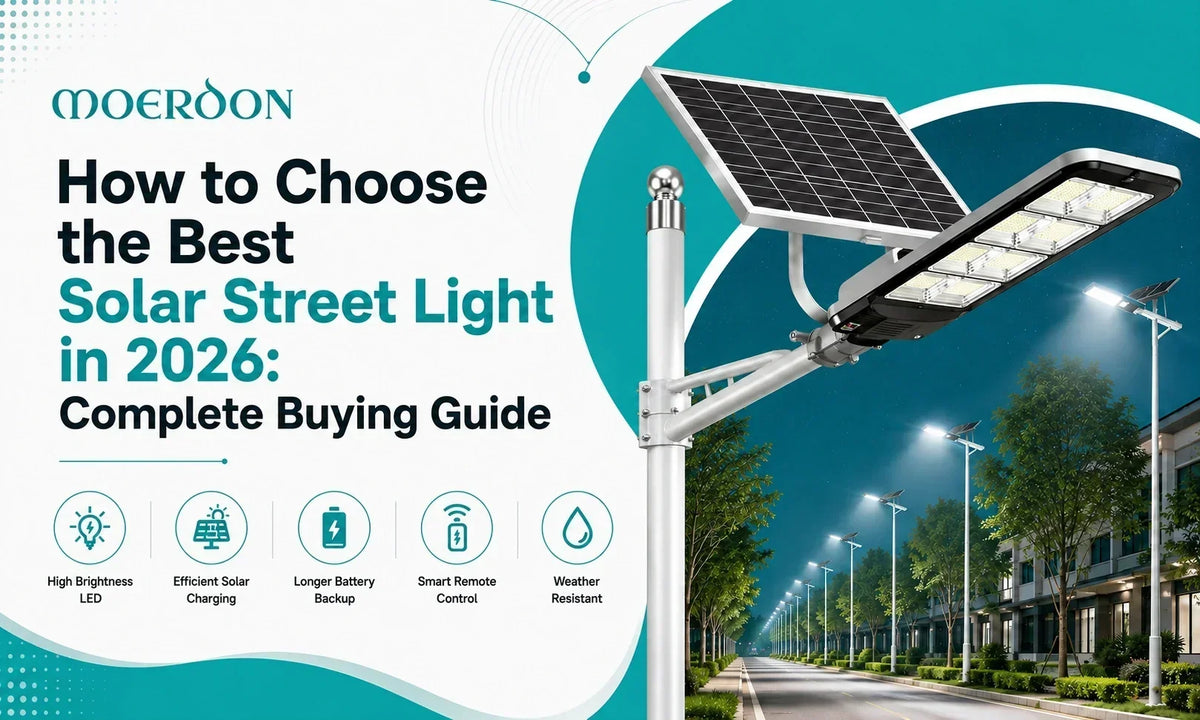
Buying solar street lights has become inevitable these days rather than being a wise choice. High electricity costs, Government campaigns for renewable energy, increasing requirement of outdoor security are some factors that influence people to opt for solar lights. If you are planning to buy solar street lights for home/garden, society, farms, street, commercial establishments, then here is a list of solar street lights that are available online (with BIS certified models) and come with warranty. Follow this step-by-step buying guide to select the perfect solar street light for your needs and read about aspects that you should consider while investing so that you don’t regret your buying decision.
What Is a Solar Street Light and How It Works
A solar street light is a self-sufficient lighting system that runs without any grid electricity. It mainly has 4 parts:
- Solar Panel - converts sunlight into electricity during the day
- Battery - stores the energy generated during the day
- LED Light - uses the stored energy to provide light at night
- Controller - automatically manages charging and discharging, and switches the light on as soon as it gets dark
The panel charges during the day, and as soon as it gets dark, the controller automatically turns the light on - no wiring needed, no manual switching. This is exactly why it's a great fit for rural areas, highways, societies, and farms alike.
Understand Your Requirement First

Before buying, get your requirement clear, because the same light doesn't work for every location.
- Where it needs to be installed - outside your home, at a society gate, on a road, on a farm, or at a factory premises. Every location has different needs.
- How much area needs to be covered - a small gate needs lower brightness, but a large road or open ground needs a more powerful light.
- How many hours of light you need - should it run all night or just a few hours. This makes deciding on battery and backup much easier.
Once these three things are clear, choosing the right product becomes much easier.
What to Check Before Buying
1. Brightness (Lumens)
Lumens indicate the brightness of the light. For a small lane or a home gate, 3,000-6,000 lumens is enough, but for a large road or open area, you need a light with higher lumens. Always ask the seller for the exact lumen number - don't rely on vague answers like "it's a bright light"z
2. Battery Type
The battery is the most important part of a solar light because it's where the entire day's solar energy gets stored.
- Lithium battery - long life, fast charging, low maintenance. Slightly more expensive but pays off in the long run.
- Lead Acid battery - cheaper, but shorter life and weaker performance, especially on cloudy days.
Check both the battery's mAh capacity and its "working hours/backup" - for example, a light with 60,000 mAh capacity may give around 10 hours of backup, while a 120,000 mAh one can give up to 20 hours.
3. Solar Panel Quality
- Mono-crystalline panel - more efficient, charges well even in limited sunlight. The better option.
- Poly-crystalline panel - average efficiency, slightly cheaper.
Mono panels perform better in the long run, especially in areas where sunlight isn't consistent.
4. How Many Days of Backup
It's important to check whether the light will still work during rainy or cloudy weather. Always ask the seller about "autonomy days" or "rainy day backup."
5. Build Quality (IP Rating)
Since a solar light is always installed outdoors, it needs to be weatherproof. An IP65 rating protects against dust and water jets, while IP67 is a step above - it's also protected against temporary water immersion. Buying a light without checking the IP rating can be risky.
6. Correct Pole Height
Height should match the area - a shorter pole is enough for a home, but roads or open grounds need a taller pole. The wrong height means the light's coverage won't work properly.
7. Sensor Feature
Good lights today come with a motion sensor and auto on/off feature - the light automatically switches on when it gets dark and off during the day. Motion sensor lights also save energy.
8. Certification and Warranty
BIS certification confirms that the product meets Indian safety standards. A warranty (at least 1 year) shows the company is confident in its own quality.
Right vs Wrong - Quick Checklist

These are signs of a good product:
- Lithium battery
- Mono-crystalline solar panel
- IP65 or IP67 rating
- BIS certified brand
- Clear warranty
- Exact lumens and mAh specifications mentioned
Watch out if you see these:
- Unusually low price (well below the market rate)
- No brand name or certification
- Lead acid battery being sold without a warranty
- Vague or missing specifications ("bright light", "long lasting" type generic words)
- Seller has no proper documentation or invoice
4 Best Solar Street Light Options 2026 (Comparison)
If you want to look at some reliable, BIS-certified options directly, here are 4 models worth comparing:
| Product | Power | Backup | Price | Best For |
|---|---|---|---|---|
| IP65 Solar Street Light with Panel | Solar panel included | Standard | Rs. 5,999 | Home, gate, small lanes - budget-friendly entry option |
| IP67 Solar Street Light with Panel | Solar panel included | Standard | Rs. 5,999 | Areas needing extra weatherproofing (rain-prone areas) |
| Coolnut Solar Street Light - 20W, 60,000 mAh | 20W, Aluminium body | ~10 Hrs | Rs. 10,000 | Society gates, medium roads |
| Coolnut Solar Street Light - 20W, 120,000 mAh | 20W, Aluminium body | ~20 Hrs | Rs. 12,000 | Roads, highways, where cloudy-day reliability matters |
Quick take:
- If budget is tight and you need basic outdoor lighting - the IP65 or IP67 model (Rs. 5,999) is a good fit.
- If you need more backup hours and a durable, aluminium-body light, the Coolnut 20 Hrs Backup model is the best choice, since 120,000 mAh capacity means the light keeps running even on cloudy days.
- All these models are BIS certified and come with a warranty, which makes them trustworthy options.
How to Spot Fake/Low-Quality Products
There are plenty of unbranded and low-quality products in the market that look fine but don't perform well.
- Always check certification - only buy BIS-marked products, as it's a basic proof of quality.
- No warranty is a red flag - if a seller hesitates to offer a warranty, it usually means they don't trust their own product's quality.
- Check reviews and feedback - talk to people who are already using the product or read online reviews to get a real sense of performance.
Installation and Maintenance Tips
- Install the panel at the right angle - place the solar panel facing the direction that gets maximum sunlight throughout the day (generally south-facing works best).
- Clean it regularly - dust build-up on the panel reduces charging, so clean it every few weeks.
- Check it periodically - keep an eye on whether the light is turning on/off correctly and whether the battery backup is fine, so any issue gets caught early.
Conclusion
Buying a solar street light isn't just about picking a light - it's a long-term investment that pays off for years if you choose correctly. Look at battery type, panel quality, IP rating, brightness, and warranty before deciding. Don't compromise on quality just to save a little, and always buy from a certified brand that offers proper warranty and support.

Leave a comment
This site is protected by hCaptcha and the hCaptcha Privacy Policy and Terms of Service apply.