
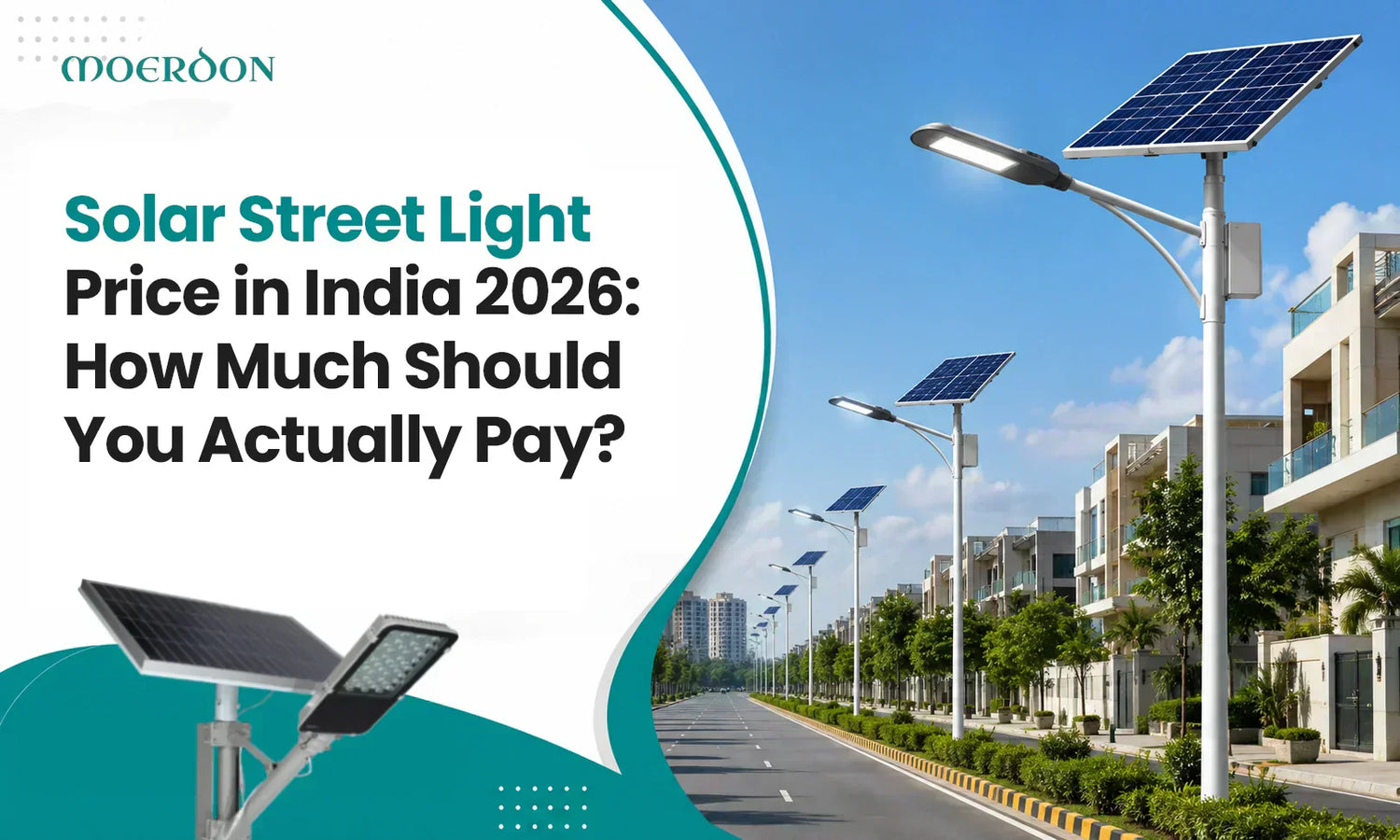
If you have been searching for a solar street light and wondering why two products that look almost identical are priced ₹3,000 apart — you are not alone. Price confusion is the single biggest hurdle Indian buyers face when shopping for solar street lights, whether they are setting up a housing society, lighting a farmhouse driveway, or upgrading a village road.
The short answer: in India in 2026, a solar street light can cost you anywhere between ₹5,000 and ₹90,000 — and both price points can be completely justified depending on what you are buying. The long answer is what this guide is about.
Let us break it down clearly, without jargon, so you know exactly what to pay for what you need.
What is the Current Price Range of Solar Street Lights in India in 2026?
Before diving into the "why," here is a quick market overview based on current pricing across product categories:
| Category | Wattage Range | Typical Price Range | Best For |
| Entry-Level / Basic | 10W – 20W | ₹5,000 – ₹8,000 | Home gate, small lane, garden path |
| Mid-Range | 20W – 40W | ₹8,000 – ₹15,000 | Housing society roads, colony streets |
| High-Performance | 40W – 80W | ₹15,000 – ₹35,000 | Commercial areas, parking lots, main roads |
| Industrial / Commercial | 80W – 120W+ | ₹35,000 – ₹90,000 | Highways, large campuses, government projects |
| Note: Prices mentioned above are for the complete unit (light + solar panel + battery + controller). Pole and installation charges are usually additional.
The wide range exists because solar street lights are not a single product — they are a system of components, and the quality of each component directly drives the price.
5 Key Factors That Determine Solar Street Light Price in India
1. Wattage and Lumen Output
This is the most obvious price driver. Higher wattage means more light, which requires a larger solar panel and a bigger battery — both of which cost more.
As a general rule, a 30-watt solar street light can illuminate roughly 20 to 25 meters of road at a standard pole height of 4 to 5 meters. If you need to cover wider roads or larger open spaces, you will need 60W or above — and the price jumps accordingly.
Do not confuse "claimed wattage" with actual output. Always check the lumen output (brightness) alongside the wattage. A 40W light with 3,500 lumens outperforms a "60W" light with only 2,800 lumens, which is common with low-quality brands.
2. Battery Type: The Single Biggest Price Differentiator
This is where most buyers get surprised — and often misled. The battery inside a solar street light can account for 30 to 50% of its total cost, and there are two main types in the Indian market right now:
Lead-Acid Batteries
- Lower upfront cost
- Heavier and bulkier
- Lifespan of 1.5 to 2 years in Indian climate conditions
- Struggles in high temperatures (common in Rajasthan, MP, Gujarat)
- Requires periodic maintenance
Lithium-Ion / LiFePO4 Batteries
- Higher upfront cost
- Lighter, compact, maintenance-free
- Lifespan of 5+ years even in India's heat
- Better charge efficiency during cloudy days
- LiFePO4 is the most heat-stable option for Indian conditions
In 2026, quality brands have shifted decisively toward lithium-based batteries — particularly LiFePO4 (Lithium Iron Phosphate) — because they offer longer lifespan and much better heat tolerance, which is critical in India's climate.
A cheap solar street light at ₹3,000 with a lead-acid battery might need a ₹2,000 battery replacement within 18 months, making your actual 3-year cost higher than a ₹8,000 lithium-based unit. Always check what battery technology is inside before buying.
3. Solar Panel Quality and Capacity

The solar panel is what charges the battery during the day. Two specifications matter here:
- Panel wattage: Higher watt panels charge the battery faster and more completely — critical during shorter winter days or monsoon seasons.
- Panel type: Monocrystalline panels offer significantly better efficiency in low-light conditions (overcast days, early morning, late afternoon) compared to polycrystalline panels.
If you live in areas with frequent cloudy weather — Northeast India, coastal Kerala, or hill states — a monocrystalline panel on your solar street light is worth paying a premium for. It will ensure your light stays on through stretches of poor sunlight.
4. IP Rating (Weatherproofing)
The IP (Ingress Protection) rating tells you how well the light is sealed against dust and water. In India, this is not optional — it is critical.
- IP65: Dust-tight and protected against low-pressure water jets (suitable for most regions)
- IP67: Dust-tight and can withstand temporary water immersion (better for heavy monsoon regions like Kerala, Assam, coastal Maharashtra)
A higher IP-rated product costs more because of better sealing, gaskets, and housing materials. But in India's rain-heavy monsoon season, it is the difference between a light that survives 5 years and one that fails in its first rainy season.
5. Smart Features: Motion Sensors, Dusk-to-Dawn Auto Operation
In 2026, motion sensors have become a near-standard feature in quality solar street lights, and they significantly impact both price and value.
What motion sensors do:
- Operate at 30-40% brightness when no movement is detected
- Jump to 100% brightness instantly when someone approaches
- This extends battery life significantly, ensuring the light lasts through longer nights or cloudy spells
Dusk-to-dawn sensors automatically turn the light on at sunset and off at sunrise — no manual switching needed. This is now standard in most mid-range and above products.
Lights with smart sensors are typically priced ₹1,500 to ₹3,000 higher than basic fixed-brightness models, but the extended battery life and added safety make them worth it for most use cases.
What Does Installation Actually Cost in India in 2026?
This is where many buyers get caught off guard. The product price and the installed price are different things. Here is a realistic breakdown of additional costs:
| Component | Approximate Cost |
| GI/MS Street Light Pole (6 metre) | ₹4,500 – ₹7,500 |
| Civil foundation work (concrete base) | ₹1,500 – ₹3,000 |
| Labour charges per point | ₹500 – ₹2,000 |
| Transportation (remote areas) | Variable |
Total installed cost per light point (mid-range product): typically ₹14,000 to ₹25,000, inclusive of the light, pole, and installation.
The good news is that unlike conventional street lights, solar street lights require zero underground cabling and no trenching work — which with traditional grid-tied lights can add ₹10,000 to ₹20,000 per pole in civil costs alone. This is one of the biggest real-world cost advantages solar lighting holds.
Also Read: On-Grid vs Off-Grid Solar Panels: Which Is Right for You?
Solar Street Light vs Conventional Street Light: The Real Cost Comparison

Many housing societies and institutions are still evaluating whether to go solar or stick with grid electricity. Here is an honest comparison over 5 years:
| Cost Factor | Conventional LED Street Light | Solar Street Light |
| Unit + installation cost | ₹8,000 – ₹12,000 | ₹12,000 – ₹20,000 |
| Monthly electricity cost (per point) | ₹120 – ₹200 | ₹0 |
| 5-year electricity cost (per point) | ₹7,200 – ₹12,000 | ₹0 |
| Underground cabling cost | ₹10,000 – ₹20,000+ | ₹0 |
| Maintenance | Periodic | Minimal |
| Works during power cuts | No | Yes |
| 5-year total cost (per point) | ₹25,000 – ₹44,000 | ₹12,000 – ₹20,000 |
Over a 5-year period, solar street lights are significantly cheaper — especially for housing societies, gram panchayats, and institutions that currently pay commercial electricity tariffs.
Who Should Buy Which Solar Street Light in India?
For Home Gates and Small Driveways
A basic 10W to 20W all-in-one solar street light in the ₹5,999 to ₹8,000 range is more than adequate. Look for a unit with motion sensor and at least 8 hours of backup.
For Housing Society Roads and Colony Streets
Go for 20W to 40W models with LiFePO4 batteries, IP65 rating, and 10+ hours of backup. Budget ₹10,000 to ₹15,000 per light point for quality units. If your society roads have trees causing partial shade during the day, choose a split-panel type for better charging.
For Farmhouses, Rural Roads, and Villages
Prioritise backup hours over raw wattage. Areas with unreliable or no grid connectivity need lights that can survive 2 to 3 consecutive cloudy days on stored battery charge. Look for 20W lights with 80,000 to 120,000 mAh capacity batteries.
For Parking Lots and Commercial Areas
40W to 80W commercial-grade lights with motion sensors are ideal. The motion sensor feature is particularly important here — it conserves battery during low-traffic hours and provides full brightness when vehicles or people are detected.
For Industrial Areas and Highways
High-mast 80W to 120W+ systems. These should be procured from brands with demonstrated commercial project experience and typically require professional installation.
Also Read: Ultimate Guide to Buying Portable Solar Panels Online in India
Is There Any Government Subsidy on Solar Street Lights in India?
Yes — solar lighting products in India can qualify for support under several central and state government schemes, particularly for rural electrification and gram panchayat projects. The PM Surya Ghar scheme and MNRE (Ministry of New and Renewable Energy) programmes have continued supporting solar adoption in 2026.
However, for residential and private commercial buyers purchasing individual units, direct subsidy on retail solar street lights is generally not applicable. Subsidies are more commonly structured for bulk purchases by municipal bodies, panchayats, and government institutions. It is advisable to check with your local district energy office or the MNRE portal for current applicable schemes in your region.
Final Verdict: How Much Should You Actually Pay?
Here is the honest answer for different buyer profiles in India in 2026:
- Home gate or small path: ₹5,999 to ₹8,000 is a fair price for a quality 10W to 20W unit.
- Housing society or colony road: Budget ₹10,000 to ₹15,000 per light for reliable, long-lasting performance.
- Commercial or institutional projects: Do not compromise below ₹20,000 per point for 40W+ systems. The cost of failure (downtime, replacement) far outweighs any upfront saving.
Anything significantly cheaper than these ranges should be evaluated very carefully — check the battery specifications, IP rating, and warranty before committing.
If you are currently comparing models for a residential or society setup, the solar street light range on MoerdonStore covers the ₹5,999 to ₹12,000 bracket with clearly specified battery capacities (up to 120,000 mAh), backup hours (10 to 20 hours), and IP ratings — making it straightforward to compare what you are actually getting for the price.
The solar street light market in India has matured significantly in 2026. Informed buyers who understand what drives pricing are making much smarter decisions — and getting lighting systems that actually last.

Leave a comment
This site is protected by hCaptcha and the hCaptcha Privacy Policy and Terms of Service apply.