
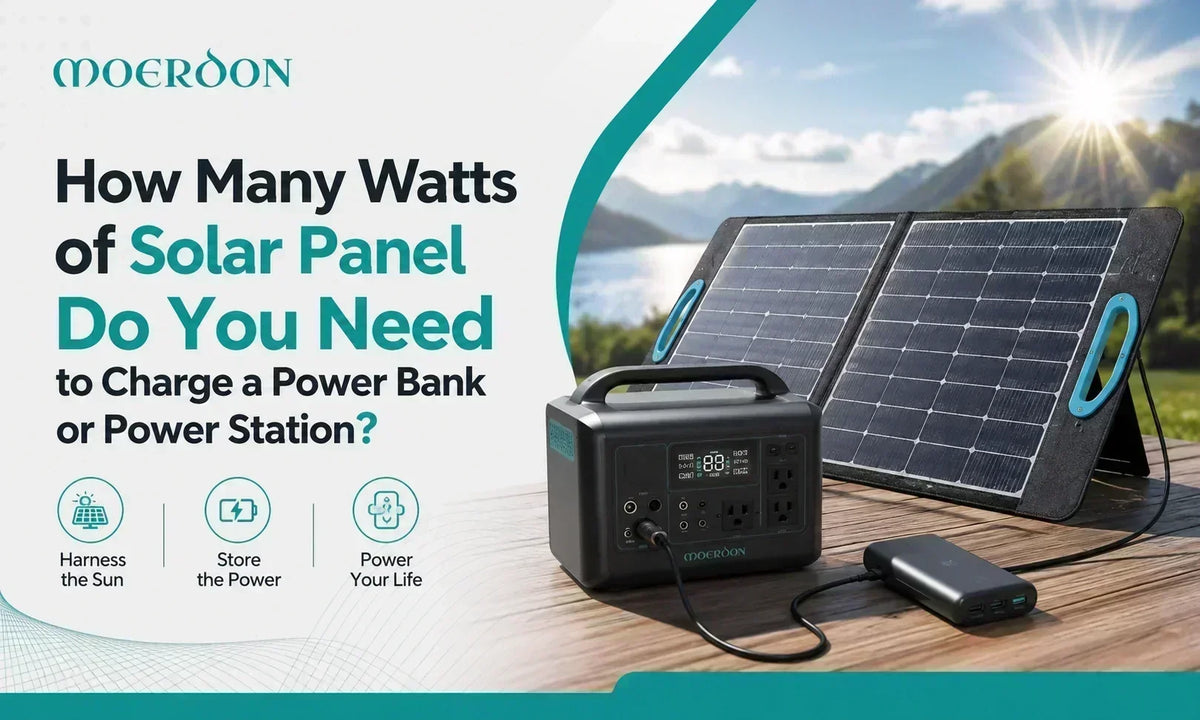
If you have ever plugged a power bank into a small solar panel and watched the charging percentage barely move, you already know the real question isn't "does solar charging work?" - it's "how many watts do I actually need for this to be practical?"
That single number changes everything. A 10W panel might trickle-charge your phone's power bank over an entire sunny afternoon, while the same panel would take days to fill a 500Wh power station. Get the wattage right, and solar charging becomes a genuinely useful backup. Get it wrong, and it becomes an expensive way to watch a battery icon crawl.
This guide breaks down the exact math, gives you ready-to-use wattage tables for common power bank and power station sizes, and explains the real-world factors - sunlight, panel type, efficiency losses - that decide whether your setup charges in two hours or two days.
Why "Watts" Is the Number That Actually Matters
Solar panels are rated in watts (W), which tells you the maximum power they can generate under ideal lab conditions - direct overhead sun, cool temperature, and a clean, unobstructed panel. Power banks and power stations, on the other hand, store energy measured in watt-hours (Wh) or milliamp-hours (mAh).
To connect the two, you need one simple formula:
Battery capacity (Wh) ÷ Solar panel output (W) ÷ Sunlight efficiency factor = Charging time (hours)
Here's what each part means in plain terms:
- Battery capacity (Wh): If your power bank is rated in mAh, convert it using:Wh = (mAh × Voltage) ÷ 1000 Most power banks report their internal cell voltage around 3.7V, so a 20,000mAh power bank holds roughly 74Wh.
- Solar panel output (W):The wattage printed on the panel - 20W, 60W, 100W, and so on.
- Sunlight efficiency factor:In real-world conditions (not a lab), you typically only get 60–75% of a panel's rated output because of cloud cover, panel angle, and heat loss. Use 0.7 as a safe average multiplier.
So a 60W panel charging a 296Wh power station under decent sun would take roughly: 296 ÷ (60 × 0.7) ≈ 7 hours of continuous, well-angled sunlight.
Matching Solar Panel Wattage to Power Bank Capacity
Standard power banks are small enough that even modest solar panels can charge them, but "can" and "conveniently" are different things. Here's a practical breakdown:
| Power Bank Capacity | Approx. Wh | Minimum Panel (slow charge) | Recommended Panel (practical charge) | Estimated Charge Time |
|---|---|---|---|---|
| 5,000mAh | ~18.5Wh | 5–10W | 10–20W | 2–3 hours |
| 10,000mAh | ~37Wh | 10W | 20–30W | 3–4 hours |
| 20,000mAh | ~74Wh | 15–20W | 30–40W | 4–5 hours |
| 27,000mAh | ~100Wh | 20W | 40–60W | 4–6 hours |
If you're regularly topping up a 10,000–20,000mAh power bank on the move, a foldable panel in the 20–30W range hits the sweet spot between portability and genuinely fast charging - small enough to clip to a backpack, strong enough that you're not waiting until sunset.
If your everyday carry is on the smaller side, it helps to first know exactly how much runtime you're working with; our breakdown on what to expect from a 5000mAh power bank is a useful starting point before you size a panel to match it.
How Many Watts Do You Need for a Power Station?

Power stations store far more energy - often 100Wh to over 1,000Wh - so the wattage math shifts significantly. Undersizing your panel here doesn't just slow things down; it can mean the station never charges past your daily usage.
| Power Station Capacity | Minimum Panel | Recommended Panel | Estimated Charge Time (recommended panel, good sun) |
|---|---|---|---|
| 150–200Wh | 30–40W | 60W | 5–7 hours |
| 300–400Wh | 60W | 100W | 6–8 hours |
| 500–600Wh | 100W | 150–200W | 6–9 hours |
| 1,000Wh+ | 200W | 300–400W | 7–10 hours |
A general rule that works well in practice : match your solar wattage to roughly one-third to one-half of your power station's watt-hour ratingif you want it to fully recharge within a single day of average sunlight. So a 500Wh station is comfortably paired with a 150–200W panel, not a lightweight 60W travel panel that's better suited to phones and power banks.
For a deeper look at pairing capacity with real-world use cases - camping, power cuts, or off-grid workdays - our guide on choosing the best portable power station in India walks through capacity selection in more detail, and pairs well with this wattage math once you've settled on a station.
What Affects Actual Solar Charging Speed in Practice
The tables above assume good conditions. In practice, several variables can push your actual charging time up or down:
1. Sunlight hours and intensity:Peak sun hours - when the sun is high and unobstructed - typically run 4 to 6 hours a day depending on season and location, even on a clear day. Early morning and late afternoon sun contributes far less than the tables assume.
2. Panel angle:A panel lying flat loses a significant portion of potential output. Angling it to face the sun directly, and adjusting through the day, can meaningfully cut your charging time.
3. Monocrystalline vs. polycrystalline:Monocrystalline panels convert sunlight more efficiently and perform better in low light, which matters if you're relying on solar charging outside peak midday hours.
4. MPPT vs. PWM charge controllers:If your power station uses an MPPT (Maximum Power Point Tracking) controller rather than a basic PWM one, you'll typically see 20–30% better energy harvest from the same panel - a detail worth checking in the spec sheet, not just the wattage number.
5. Heat: Solar panels lose efficiency as they heat up. On a hot day, real output can drop noticeably below the rated wattage, which is one reason the 0.7 efficiency factor in the formula matters.
6. Cable and connector losses: Long or thin cables between panel and device introduce voltage drop. Keeping cable runs short, and using the connector type your power station's manufacturer recommends avoids losing capacity you already paid for.
If you already own a power station and want a step-by-step process for connecting a panel correctly - polarity, connector types, and safe charging order - this guide on how to charge a portable power station safely and quickly covers the practical setup side that complements the wattage math here.
Choosing the Right Solar Panel: What to Actually Look For
Beyond raw wattage, a few practical details separate a panel that's genuinely useful from one that underdelivers:
- Foldable and lightweight design if you're charging power banks on the move - trekking, commuting, or outdoor shoots.
- Higher wattage (100W+) with MPPT compatibility if you're regularly recharging a power station rather than a handheld power bank.
- Weather resistance, since outdoor and camping use exposes panels to dust, light rain, and temperature swings.
- Correct output connector (DC barrel, USB-C PD, or MC4) matched to your specific power bank or power station model, to avoid conversion losses.
If you're putting together a complete off-grid or camping setup — solar panel, power station, and the cables to connect them — it's worth rounding out the kit with basic safety gear too. A compact portable fire extinguisher takes up barely any room in a car boot or camping bag, and it's the kind of item you'll hopefully never need but will be glad to have alongside any setup that involves batteries, heat, and long unattended charging sessions in the sun.
This is where having the right panel - not just any panel - makes the difference between "it technically works" and "it keeps my gear running all trip." Moerdon's range of solar panels is built around exactly this pairing logic, with foldable solar panels sized for power banks and daily carry, alongside higher-wattage options suited to recharging a power station during travel, outdoor shoots, or power cuts. If you're building a complete off-grid charging setup rather than buying the two separately, our guide to portable power stations with solar panels walks through how to pair a compatible panel and station so you're not guessing at wattage compatibility after the purchase.
And if your primary need is simply keeping a phone alive on the trail rather than running a full power station, it's worth comparing dedicated options first - our roundup of the best solar mobile chargers for travel, camping, and emergencies covers compact, phone-focused alternatives that may suit lighter use cases better than a general-purpose panel.
Conclusion
The right solar panel wattage isn't about buying the biggest one you can find - it's about matching panel output to your battery's actual watt-hour capacity, then accounting for real-world losses from angle, weather, and cable quality. As a working rule: pair power banks with 20–60W foldable panels, and pair power stations with panels rated at roughly a third to half of their watt-hour capacity for a full day's charge.
Once you know the number that fits your device, the rest is straightforward - a well-matched panel, a good charging window, and a battery that's actually ready when you need it. Explore Moerdon's solar panel and power station range to find a setup sized correctly for your power bank or power station from the start.

Leave a comment
This site is protected by hCaptcha and the hCaptcha Privacy Policy and Terms of Service apply.